How to get involved
Learn how to get involved in the project.

Clean Energy Link- Moora-Chittering is in Phase Two of the Clean Energy Link program of works. It will focus on building the transmission infrastructure needed to meet future demand for electricity from homes and growing industries beyond 2030. The timing and delivery of this next stage will be guided by how quickly and where new industrial growth happens, while also ensuring the network remains safe and reliable as more renewable energy is added to the system.
The next stage of Phase Two projects may need to be delivered as early as 2032. Because major transmission projects take many years to plan and build, some decisions about these priority Phase Two works may need to happen while Phase One (Clean Energy Link North and East) is still being delivered.
Clean Energy Link – Moora-Chittering is a proposed project to expand and strengthen the transmission network in the Wheatbelt, to connect new renewable generation and support future forecasted growth from both industry and household electricity demand.
We’re currently in early planning and scoping for both terminal sites and line route corridors. A key priority of this project will be identifying terminal locations to assist renewable energy projects develop and gain approval for the connection of their assets ahead of construction.
Clean Energy Link – Moora-Chittering project is
being proposed to expand and strengthen the power network across the Wheatbelt.
It will help connect new wind and solar farms and support future growth for
local industries and communities.
Scoping is underway to identify what new and upgraded infrastructure is needed to support major projects across the Wheatbelt. This work will help boost the flow of clean energy between the region and Perth, opening up new opportunities for local communities and businesses.
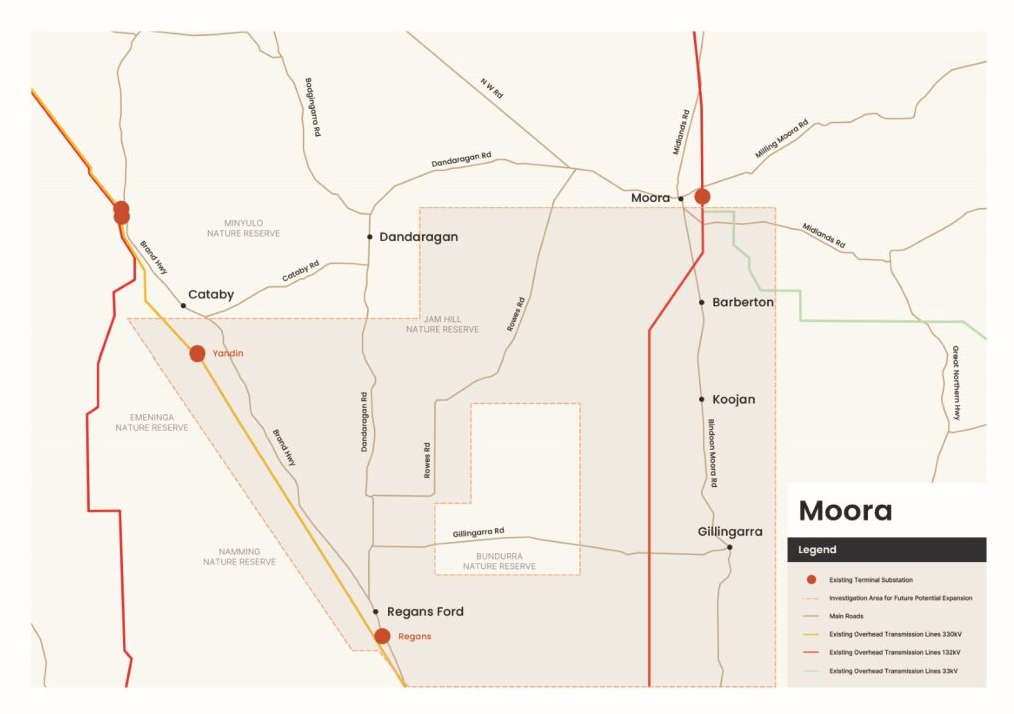
Clean Energy Link Moora requires new terminal locations to be located within the orange marked area on the above map to support the connection of new renewable projects and industrial developments in the region.
In addition to new terminals, Clean Energy Link Moora requires upgrades to existing transmission infrastructure and the construction of new 330kV infrastructure to enable new renewable generation to connect from Central Midlands to supply loads in the metropolitan and southern SWIS regions. Existing corridors will be used wherever possible when constructing new transmission infrastructure to minimise impacts on landowners, community and environment.
In the Moora and Central Midlands region, the additional transmission lines and terminals will make it possible for new industries to connect. this increases the amount of renewable energy generated in the region which power homes and businesses across the metropolitan area and the southern parts of the grid. The transfer capacity between Neerabup and the Central Midlands is expected to increase by about 1,600 MW in both directions.
Western Power will work with landowners, community and industry to inform scoping and planning of terminal locations and transmission expansion and support the Government in making future infrastructure decisions.
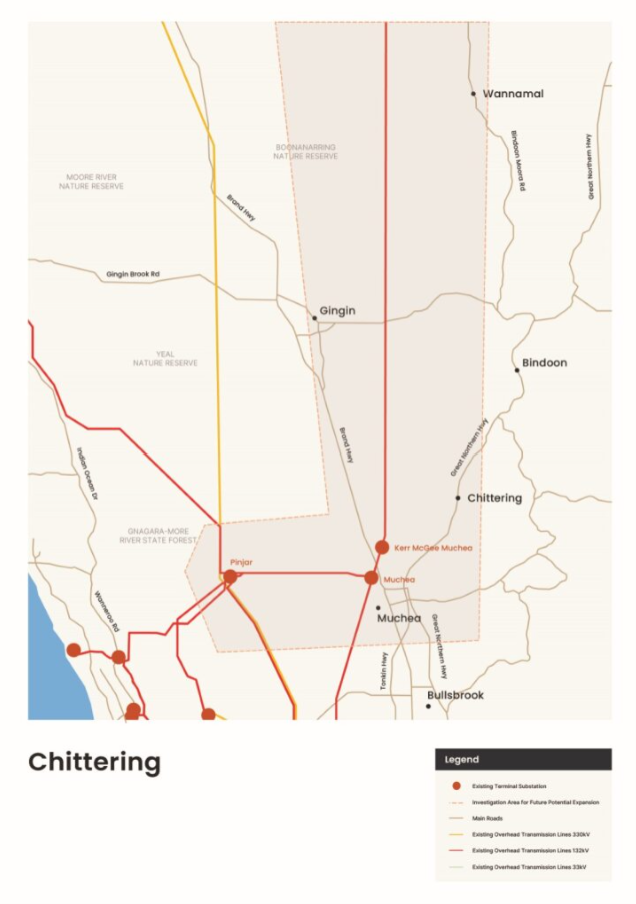
This project is investigating the following upgrades within the orange area marked in the enclosed map to support the connection of new renewable projects and industrial developments in the region.
Western Power will work with landowners, community and industry to inform scoping and planning of terminal locations and transmission expansion and support the Government in making future infrastructure decisions.
This project is investigating the upgrades within the orange area marked in the above map to support the connection of new renewable projects and industrial developments in the region.
The proposed new terminal and new circuits to the Neerabup Terminals will boost the capacity of the network between Perth’s northern suburbs and Neerabup. This upgrade will make it easier to connect new renewable energy sources and support growing industrial areas, increasing energy transfer capacity by around 1,600 MW in both directions.
Clean Energy Link Chittering will be scoped in several stages, enabling us to effectively manage connections for renewable energy generation projects underway in the Mid-West of WA whilst we keep electricity supply to the area secure.
First announced by the State Government in 2023, the Clean Energy Link Program is delivering network infrastructure needed to connect more solar and wind farms as part of WA’s drive to be a world-leading renewable energy powerhouse.
Western Power will plan, build and manage new transmissions lines and new terminals across the South West Interconnected System (SWIS) to meet WA’s growing demand for renewable energy resources.
As outlined in the SWISDA, Clean Energy Link will be delivered in phases with Moora-Chittering considered part of Phase Two implementation (2032-2035 delivery).
Moora-Chittering is in the scoping phase, and still requires design development, investment decisions and relevant approvals, including environmental, to move forward. We’ll continue to provide updates related to timelines as the project progresses.
Renewable generators and industrial developments are responsible for connections from their projects to the network. Western Power will work closely with project proponents to ensure they meet our requirements and expectations.
Once we have engaged with the landowners, stakeholders and community and received feedback on the proposed project this will be provided to Government for determination.
While expanding the transmission network will not directly improve reliability on the distribution network, the overall benefits stemming from a clean energy network for the whole community will be momentous. Western Power is doing everything we can to improve distribution network resilience in the face of increasing climate change weather impacts to minimise the frequency and duration of power outages, with a number of initiatives already underway.
Learn how to get involved in the project.

Have questions or want to learn more about a project, contact us below:
| Name | Western Power |
|---|---|
| Phone | 13 10 87 |