Western Power is delivering the network infrastructure needed to achieve the State Government’s vision for WA as a world-leading renewable energy powerhouse. The network’s transmission lines, and the wind and solar farms they will connect, will form one of the largest infrastructure, technology and construction transformations in Western Australia’s history.
Western Power’s network plays an important part in safely and reliably transferring more clean energy generated from wind and solar farms in regional areas to homes and businesses.
Clean Energy Link – East is a proposed project to expand the transmission network east of Collie, to connect new renewable generation sources to enable industry and the wider community to meet decarbonisation goals.
Connecting these sources will:
- provide access to more renewable energy sources
- keep WA's main electricity network stable with the expected growth in future demand
- help us all reach net-zero by 2050.
About the project
Project overview
We’re currently planning and scoping for this expansion in several stages enabling us to manage connections for projects already well-progressed, while supporting a smooth and efficient integration for future energy needs.
Clean Energy Link – East is in the planning phase to guide design development and support a business case for investment. The project will require approvals, including environmental assessments, and government funding allocation to move forward.
During the planning phase we consider locations of proposed renewable energy generators, ways to minimise community impact, landscape and environmental values, constructability, location of existing infrastructure and cost benefits for Western Australians.
We’re committed to working closely with stakeholders in the community, landowners and industry and will continue to provide updates as the proposed project progresses.
Stage One
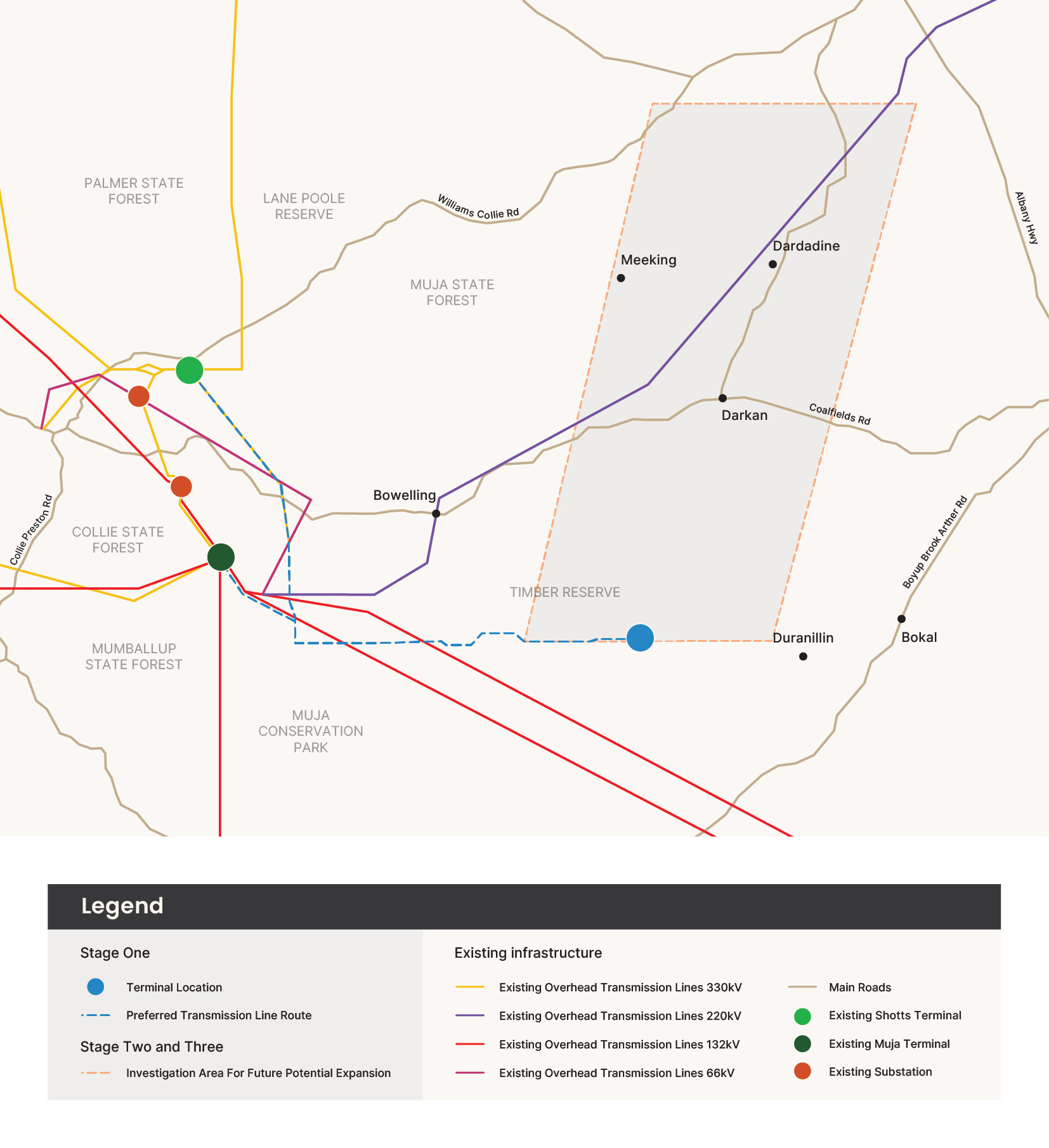
To support WA’s commitment to retire state-owned coal generation by 2030, Stage One proposes to expand the network by delivering:
- a new terminal south of Darkan, providing a critical network connection point for renewable projects advancing in the area, unlocking significantly more clean energy.
- two new double-circuit 330kV transmission lines to connect the proposed new terminal back to the existing Muja and Shotts terminals.
This network upgrade is essential due to capacity and location constraints of the existing terminals at Muja and Shotts.
Community and stakeholder feedback and insights are important in determining the line design and will help inform industry and government decisions.
Stage Two and Three
This new terminal would also allow for future network expansion to the north-east where a number of other renewable energy generation projects are proposed. To inform these long-term investigations, continued stakeholder and community engagement will be undertaken.
Project map
Project updates
Clean Energy Link – East funding gets the green light
April 2026
Clean Energy Link – East is poised to shift from planning to delivery thanks to the announcement of the State Government’s new $1.4 billion Clean Energy Fund.
The fund has been designed to support major projects that deliver cleaner, more reliable and affordable energy for Western Australians. In Clean Energy Link - East this will allow new wind and solar projects to connect east of Collie.
Western Power Clean Energy Link Development Manager East Warren Phillips said the funding and designation to soon move to a priority project creates strong momentum.
“This investment gives the project certainty,” he said.
“Clean Energy Link – East will open the door for new renewable projects, support industry growth and help keep energy affordable and reliable for the community.
“It’s a major step forward for WA’s clean energy future, and we’re ready to deliver.”
Clean Energy Link – East (Stage One) is currently in the planning and approvals phase and is on track to support WA’s commitment to retire State-owned coal generation by 2030.
The project will expand the network by delivering:
- a new terminal south of Darkan, providing a critical network connection point for renewable projects advancing in the area, unlocking significantly more clean energy
- two new double-circuit 330kV transmission lines to connect the proposed new terminal back to the existing Muja and Shotts terminals
- upgrading to the existing Muja and Shotts terminals in Collie to increase capacity and address future constraints.
Follow the link to view the full State Government Statement
Government plans WA's clean energy future with $1.4 billion fund
Stage One terminal location secured
November, 2025
Western Power have secured land for the proposed terminal south of Darkan, as part of Stage One of Clean Energy Link - East.
We have also been engaging with landowners and other stakeholders on the transmission study corridor. Based on this feedback, a preferred transmission line route has been identified.
Both the location for the proposed terminal and the preferred transmission line route are marked in blue on our project map. Ongoing investigations and engagement with landowners is required to finalise the transmission line route.
To enable detailed scoping and planning, Western Power’s preliminary funding for Clean Energy Link -East included budget allocation to purchase land for the proposed new terminal south of Darkan. We still require Government funding and the necessary approvals to build the terminal and the transmission infrastructure to deliver Stage One. To secure this funding, we must include current market costs in our business case.
Contractors from our panel will soon engage with industry and local businesses to gather cost estimates for the proposed works. These estimates will help shape our business case.
Frequently asked questions
First announced by the State Government in 2023, Clean Energy Link Program is delivering the network infrastructure needed to connect more solar and wind farms as part of WA’s drive to be a world-leading renewable energy powerhouse.
Western Power will plan, build and manage new transmissions lines and new terminals across the South West Interconnected System (SWIS) to meet WA’s growing demand for renewable energy resources.
The project is in the planning phase, and still requires design development, investment decisions and relevant approvals, including environmental per stage. We will continue to provide updates related to timelines as the project progresses.
Enhancing infrastructure alongside sections of the existing 132kV line is an option Western Power is considering. While no decisions have been made for the connections from Muja Terminal and Shotts Terminal to the potential new terminal, using the existing 132kV line for this section poses a number of potential challenges. These include the ability to maintain network flexibility during power outages and longer-term energy infrastructure planning in the area. As the Clean Energy Link Program develops, some sections of the network enhancement may use this 132kV line.
Additionally, this line is not on a registered easement, which will be a requirement for the 330kV lines being built as part of the project. Easements ensure Western Power employees and contractors can access the site in the future to undertake maintenance and other works.
Renewable generators are responsible for connections from their projects to the network. Western Power will work closely with the renewable generators to ensure they meet our requirements and expectations.
Once we have engaged with the landowners, stakeholders and community and received feedback on the proposed project this will be provided to Government for determination.
While expanding the transmission network will not directly improve reliability on the distribution network, the overall benefits stemming from a clean energy network for the whole community will be momentous. Western Power is doing everything we can to improve distribution network resilience in the face of increasing climate change weather impacts to minimise the frequency and duration of power outages, with a number of initiatives already underway.